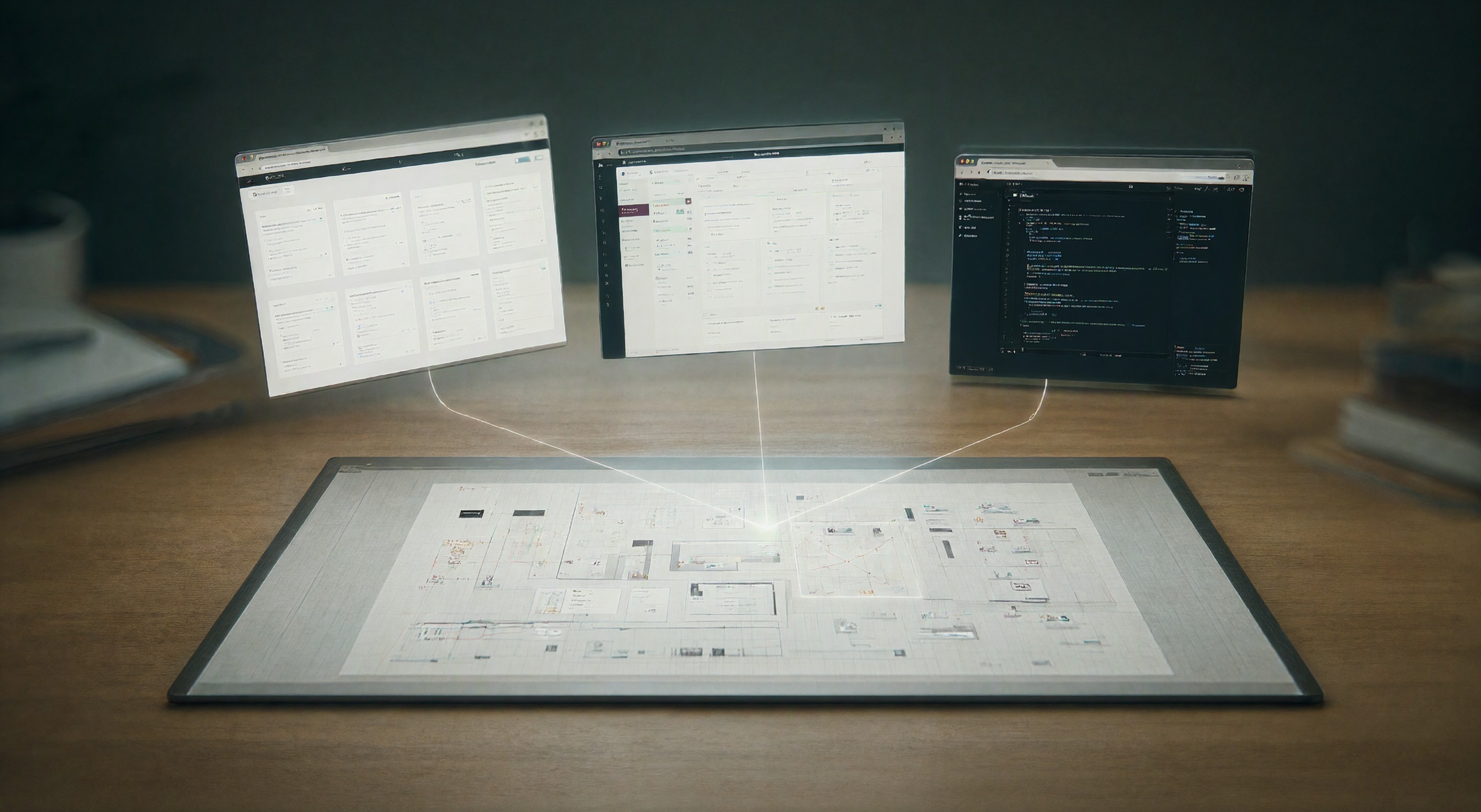
On 1 November Figma shipped an update that lets teams work with coded prototypes directly inside the design canvas. The move completes a run that started at Config 2026, where the company launched Code Layers and Motion, and continued through Weave, whose agents now publish tools inside an organization's own workspace. The file that used to end at a row of mockups now contains working frontend code. The handoff meeting, the redline document, the "looks good, ship it" reply: that whole ritual is dissolving into the canvas it used to divide.
The review question changes
A mockup asks one question: does this look right? A coded prototype asks a better one: does this behave right? CMSWire's Config coverage made the point that designers now create interactive code directly in Figma, which means the motion you review is the motion that ships. Comments land on working states. A transition that felt elegant in a video export can feel sluggish in the prototype, and you learn that while the cost of change is still low.
The redline disappears with it. Spacing, type scale, and breakpoints used to travel as annotations a developer interpreted. In a code layer they travel as values the browser reads. Interpretation was where handoffs leaked.
What the agent takes over
The mechanical half of the old handoff, turning a canvas into markup, is becoming an agent's job. Figma's own roadmap points there, and the comparison posts now test Dev Mode, Code Connect, Zeplin, Anima, and Locofy against that standard. Hedrick's 2026 handoff tool survey describes the category compressing around one question: which tool lets the agent read the design without a human in the middle. The export step survives only for teams that keep two sources of truth.
We already work this way on the other side of the pipeline, and the lesson matches. This blog ships through agents: one writes the Markdown against a skill file that carries our voice rules, another builds the static site, a third uploads and checks the HTTP status. No designer hands a file to a developer, because the brief and the build live in the same place. When Figma's release notes describe teams publishing Weave tools inside their org, they describe the same contract: the rules become configuration, and the agent reads them. Adobe made the same move inside Creative Cloud, and our own posts run on the smaller version of it.
The state the prototype hides
One warning before you delete the handoff ritual. A coded prototype shows the happy path, because the happy path is what the prompt describes. The empty state, the error state, the loading delay, the row with four hundred characters where the design assumed forty: those lived in the redline's fine print. The handoff carried them forward as annotations. Dissolve the handoff and somebody has to carry them on purpose.
So the craft moves to specification. Write the states the prototype will not show you: what the card looks like with no image, what the form returns on a server timeout, which breakpoint gets the compressed nav. The builders we reviewed in October all fail the same way on that front: fast on the demo path, silent on the edge cases. The tool will not ask about the four-hundred-character row. You still have to.
The handoff is dissolving because its two jobs split apart. Translation to code goes to the agent. Specification of everything the demo path hides goes back to you, in writing, before the first render. Teams that keep writing those lists will ship faster than they did with redlines. Teams that stop writing them will ship the happy path and meet the other states in production.
Sources
The reported facts in this post come from these outlets:
- Figma release notes documented the November updates: coded prototypes on the design canvas and published Weave tools inside organizations.
- CMSWire covered the Config 2026 launch of Code Layers and Motion, which lets designers create interactive code directly in Figma.
- Qubika rounded up the Config 2026 announcements for designers: Motion, Code Layers, shaders, and agent upgrades.
- Hedrick compared the 2026 handoff tool landscape, including Figma Dev Mode, Code Connect, Zeplin, Anima, and Locofy.